From the Factory, Tips & Tutorials | August 27, 2026
What Is a Terz Guitar? How to Tune the Martin 5-28 Terz
The smallest guitar in the Martin lineup has a higher voice, a long musical history, and one important requirement: choosing the right strings for the tuning you plan to use.

The Martin 5-28 Terz might look like someone put a full-size Style 28 through a shrink ray.
It has a gloss spruce top and East Indian rosewood back and sides, classic Style 28 appointments, and all the craftsmanship you would expect from a Martin Standard Series guitar. It simply packs those details into an ultra-compact Size 5 body with a remarkably short 21.38-inch scale.
But calling it a small guitar only tells part of the story.
The feature that truly makes the 5-28 a Terz is its tuning. Instead of standard E–A–D–G–B–E, it is designed to be tuned a minor third higher, to G–C–F–A♯–D–G.
That higher register gives the guitar its focused, bell-like sound—and can make familiar chord shapes, riffs, and arrangements feel completely new.
So, what exactly is a Terz guitar? How do you tune one? And which strings should you use? Let’s dig in.

What Is a Terz Guitar?
A Terz is a guitar designed to play in a higher register than a standard-tuned guitar.
The name refers to the interval between standard tuning and traditional Terz tuning: a minor third, or three semitones. Raise every string on a standard guitar by that interval, and you arrive at Terz tuning.
The defining open-string notes, from lowest to highest, are:
G–C–F–A♯–D–G
You may also see the fourth string written as B♭ instead of A♯. Those are two names for the same pitch, so either reading on a digital tuner is correct.
This higher tuning gives the instrument a clear, concentrated voice that naturally occupies a different space than a standard acoustic guitar. Played by itself, a Terz sounds bright, lively, and articulate. Layered with another acoustic guitar, it can introduce shimmer and dimension without simply doubling the same frequencies.
It is not a ukulele, and it is more than simply a scaled-down or student guitar. Although Martin historically described the Size 5 as a “Junior” or three-quarter-size model, its identity as a Terz comes from its higher tuning and distinctive musical role.
It is a six-string acoustic guitar with its own tuning, scale length, sound, and place in an arrangement.

A page from Martin’s 1960 catalog features the Size 5 5-18, then described as a “Junior” three-quarter-size guitar with a spruce top, mahogany back and sides, and a 12-fret body design.
A Small Guitar with Deep Martin Roots
The Size 5 reaches back to the earliest chapters of Martin history and is the oldest Martin guitar shape and style still made today.
Its proportions reflect an era when guitars were generally smaller than the instruments that would later fill concert halls, recording studios, and stadium stages. As music changed, larger body sizes became increasingly prominent—but the Size 5 never completely disappeared.
Instead, it developed a personality all its own.
Compact, comfortable, and capable of producing a uniquely high voice, Size 5 Martins became useful instruments for writing, traveling, recording, and finding sounds that a larger standard-tuned guitar could not quite replicate.
The new Martin 5-28 Terz brings that historic format back to the Standard Series and, at launch, became the smallest guitar in the 2026 Martin lineup.
For perspective, its 21.38-inch scale is shorter than Martin’s traditional 24.9-inch short scale and even shorter than the 23-inch scale found on Little Martin guitars.
Yet this is every bit a Style 28 Martin. Its solid spruce top is paired with solid East Indian rosewood back and sides, while antique white binding, a Style 28 rosette, multi-stripe top inlay, and mother-of-pearl dot fingerboard inlays give it a familiar, premium appearance.
Non-scalloped ¼-inch spruce X-bracing helps provide focus and definition, while its ebony fingerboard, ebony bridge, bone nut, and bone saddle support a clear and responsive voice.

Famous Musicians Who Have Played Terz and Size 5 Guitars
The Size 5 and Terz format may be unusual, but it has attracted an impressive list of artists across country, folk, rock, pop, blues, jazz, and acoustic music.
Marty Robbins is perhaps the musician most closely associated with the Martin Size 5. Its bright, compact voice fit naturally into his distinctive approach to country and Western music and helped make the little Martin recognizable to generations of players.
Below, you can watch that connection in action in a 1969 performance of “Devil Woman” from The Marty Robbins Show, where Robbins plays a Size 5 Martin and puts its clear, higher voice front and center.
Other notable artists associated with Terz or Size 5 guitars include:
- Johnny Cash
- Billy Corgan
- Grant Geissman
- Bobbie Gentry
- Michael Hedges
- John Mayer
- Tony McManus
- Steve Miller
- Dolly Parton
- Sting (pictured above)
- Neil Young
That is a remarkably varied group of musicians for such a specialized instrument.
Some have used the Size 5 as a writing or travel guitar. Others have taken advantage of the higher register for studio layering, alternate voicings, and parts that need to stand apart from a standard acoustic track. And for players like Billy Corgan of The Smashing Pumpkins, the idea of a Terz has even carried over into the electric-guitar world.
The common thread is perspective. A Terz invites a musician to hear familiar ideas differently.
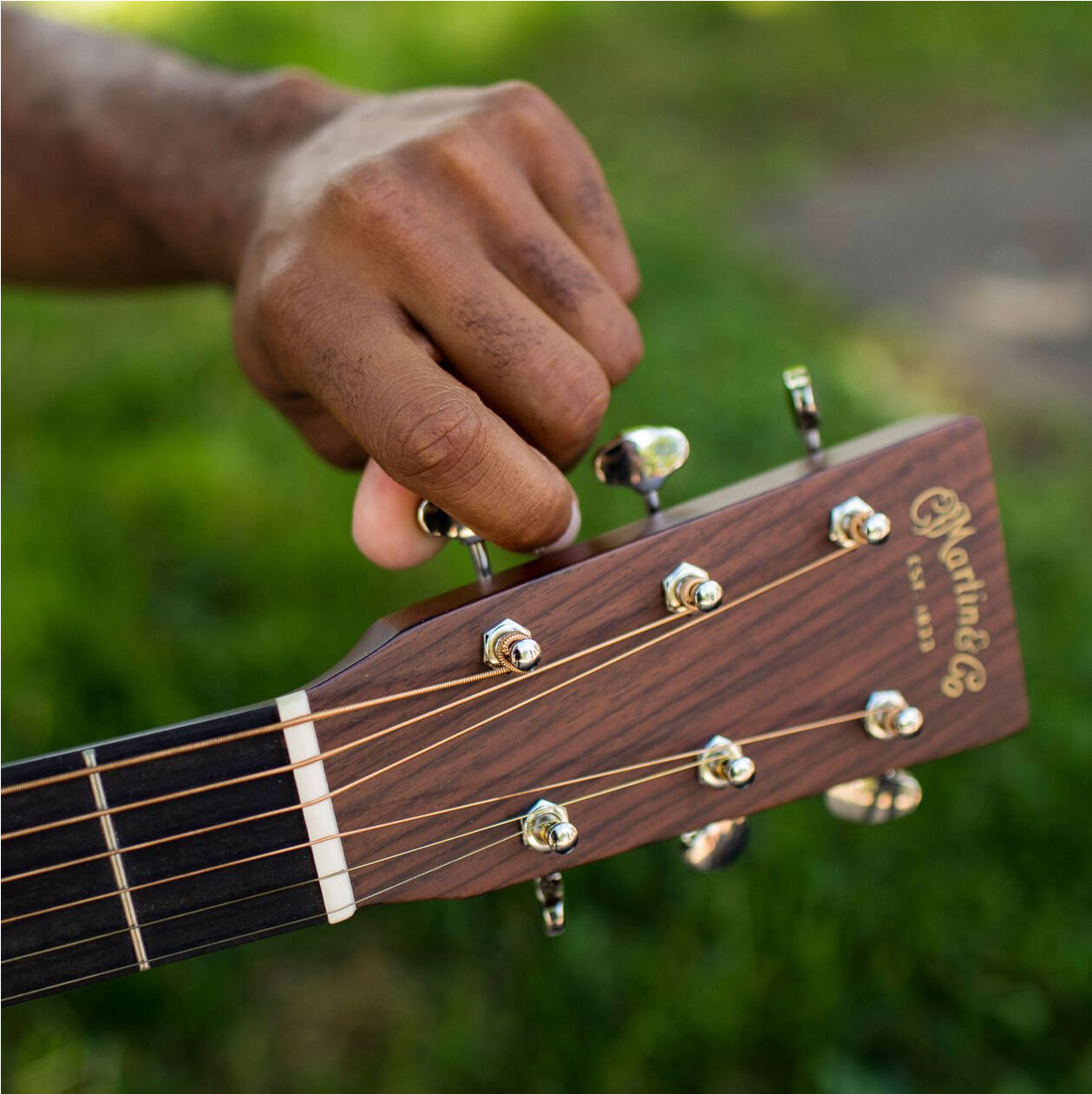
How to Tune the Martin 5-28 Terz
The 5-28 Terz leaves the Martin factory set up for traditional Terz tuning.
Using a chromatic tuner, bring the strings to the following pitches from lowest to highest:
6th string: G
5th string: C
4th string: F
3rd string: A♯ or B♭
2nd string: D
1st string: G
Tune each string gradually, especially when installing a new set. Once all six strings reach pitch, check them again from the sixth string to the first.
As the total tension settles across the guitar, some strings may move slightly out of tune. A few passes with the tuner should bring everything into balance.
When the tuner reads G–C–F–A♯–D–G, you are ready to play.
Is Terz Tuning the Same as Using a Capo?
Placing a capo on the third fret of a standard-tuned guitar produces the same open-string pitches as Terz tuning.
That makes the capo a useful way to preview the register. Tune your regular guitar to standard, place a capo at the third fret, and you can hear how your familiar chord shapes sound when raised a minor third.
But the playing experience is not identical.
A capo removes the first three frets from the usable fingerboard and shortens the vibrating length of the strings on a guitar designed for standard tuning. The 5-28 Terz is built around its compact body, short but full 21.38-inch scale, and higher pitch from the start.
You get the entire fingerboard, open strings tuned to Terz pitch, and the quick, focused response of a guitar designed specifically for that register.
Watch: Terz Tuning and Choosing the Right Strings
The 5-28 Terz is strung just like any other six-string acoustic guitar. The important difference is choosing a string gauge that matches the tuning you plan to use.
In the video below, Martin’s Dave Doll explains the recommended strings for traditional Terz tuning and standard tuning—and why matching the gauge to the pitch helps maintain the guitar’s proper tension, feel, and intonation.
What Strings Should You Use on the Martin 5-28 Terz?
Restringing the 5-28 Terz works the same way as restringing another acoustic guitar.
You remove and replace the strings normally. There is no special string order, unusual installation method, or different type of bridge pin involved.
What changes is the gauge you should choose for each tuning.
For Terz Tuning: Use Custom Light Strings
For traditional G–C–F–A♯–D–G Terz tuning, Martin recommends:
Martin Authentic Acoustic® Lifespan® 2.0 Custom Light strings
The 5-28 Terz ships with these strings from the factory.
Because the guitar is tuned three semitones higher than standard pitch, custom light strings help provide the proper tension across its short 21.38-inch scale. They give the guitar the intended balance of playing feel, intonation, responsiveness, and tonal clarity.
Heavier strings tuned to Terz pitch would create additional tension beyond what is necessary for the instrument’s intended setup.
For the traditional Terz experience, stick with Custom Light strings.
For Standard Tuning: Use Medium Strings
The Martin 5-28 Terz can also be tuned to standard E–A–D–G–B–E.
However, lowering Custom Light strings from Terz pitch to standard pitch reduces their tension. The strings may feel unusually loose, and the guitar may not respond or intonate the way it was intended.
Players who plan to keep the guitar in standard tuning should use:
Martin Authentic Acoustic® Lifespan® 2.0 Medium strings
The heavier gauge helps compensate for the lower pitch and restores a more appropriate level of string tension.
Changing from Custom Light to Medium strings can affect the neck relief, action, nut slots, and intonation, so it is a good idea to have the guitar’s setup checked by a local Martin dealer or authorized service center.
The simplest way to remember it is:
Terz tuning: Lifespan Custom Light strings
Standard tuning: Lifespan Medium strings and a setup check

Can You Switch Between Terz and Standard Tuning?
You can use the 5-28 Terz in either tuning, but it is best to decide which one you plan to use most often and select the corresponding strings and setup.
Frequently moving Custom Light strings between Terz and standard pitch may leave the guitar feeling too loose when tuned down. Likewise, repeatedly tuning Medium strings up to Terz pitch would create considerably more tension.
The guitar offers versatility, but the string gauge and setup should follow the tuning—not the other way around.
Players who want the instrument’s intended higher voice should keep it in Terz tuning with Custom Lights. Players who prefer familiar standard pitch should use Medium strings and have the setup evaluated.
How to Use a Terz Guitar in Your Music
Once the guitar is tuned correctly, the fun begins.
The 5-28 Terz can turn familiar chord shapes into a different set of actual pitches, which makes it a useful tool for songwriting and breaking out of established patterns. Shapes your hands could play automatically may suddenly suggest new melodies, vocal ranges, and harmonic ideas.
Its higher voice also gives it a natural role in layered arrangements.
Try pairing it with a standard-tuned acoustic guitar. Rather than recording two nearly identical parts in the same register, use the Terz to add a brighter complementary voice above the main guitar.
It can also be used to:
- Add shimmer and definition to an acoustic arrangement
- Double a melody in a higher register
- Create bright rhythm parts that cut through a mix
- Explore new vocal keys using familiar chord shapes
- Add mandolin-like clarity while retaining six-string voicings
- Bring a different texture to folk, country, blues, pop, and rock recordings
- Make an old song feel new again
The 5-28 Terz is also compelling on its own. The solid East Indian rosewood back and sides add depth and overtone character, while the spruce top and focused bracing help keep its higher voice clear rather than thin or harsh.

A Different View of the Guitar
The 5-28 Terz may be the smallest guitar in the Martin lineup, but its purpose is much bigger than portability.
It connects the earliest eras of Martin history with a sound that remains useful in modern songwriting, recording, and performance. Its Size 5 body offers a distinctive playing experience, its Style 28 construction brings depth and refinement, and its higher tuning encourages players to approach familiar ideas from a new angle.
Remember the essential formula:
G–C–F–A♯–D–G with Custom Light strings.
E–A–D–G–B–E with Medium strings and a setup check.
String it like any other acoustic guitar, choose the gauge that matches your tuning, and let one of Martin’s smallest instruments lead you somewhere new.
Explore the Martin 5-28 Terz and discover the big creative possibilities behind its compact design.
Until next time, happy playing!


